- Assumed uptime
- 85%
- Assumed task hours/year
- 660,000
- Annual modeled uses
- $281.0m
AETHER / EVIDENCE YOU CAN INSPECT
Show the system.
Show its limits.
The ambition is planetary. The useful next test is regional: one process, shared physical constraints, two operating cases and a ledger that can be checked.
This is conditional research. The example below is neither a real plant proposal nor a forecast. It shows how a carbon service would have to account for its work.
01 / A BOUNDED OPERATING EXAMPLE
Same process.
Different execution.
A 1 MtCO₂/year gross nameplate benchmark anchored to a published NETL solvent-DAC process. Only assumed uptime, task hours and explicit automation costs change between the two cases.
- Assumed uptime
- 90%
- Assumed task hours/year
- 345,000
- Annual modeled uses
- $275.6m
The automation-assisted case includes $12m/year of additional system cost. Higher uptime and fewer task hours are hypotheses to test—not capabilities already demonstrated by AETHER.
Open the physical ledger and energy requirements
| Accounting layer | Ordinary | Assisted |
|---|---|---|
| Gross capturetCO₂/year | 850,000 | 900,000 |
| Gross storedtCO₂/year | 847,452 | 897,302 |
| Physical retentiontCO₂/year | 843,214 | 892,815 |
| Project emissions (debit)tCO₂e/year | 45,091 | 47,743 |
| Net after project emissionstCO₂e/year | 798,124 | 845,072 |
| Risk-adjusted creditstCO₂e/year | 758,696 | 803,326 |
Electricity and thermal energy have separate boundaries. Ordinary operations use 453.2 GWh/year and 5.82 PJ/year of fuel-input-equivalent thermal energy; the assisted case uses 479.8 GWh and 6.16 PJ. The thermal proxy derives from NETL’s natural-gas HHV input, not delivered useful heat. Low-carbon substitution, temperature, conversion efficiency and hourly availability still need engineering evidence.
Every parameter, unit and evidence label02 / FOLLOW THE ACCOUNTING
Three views of the same case.
These figures and the website numbers are generated from the same checked-in regional outputs used by the paper.
A captured tonne is the start of the ledger.
AETHER model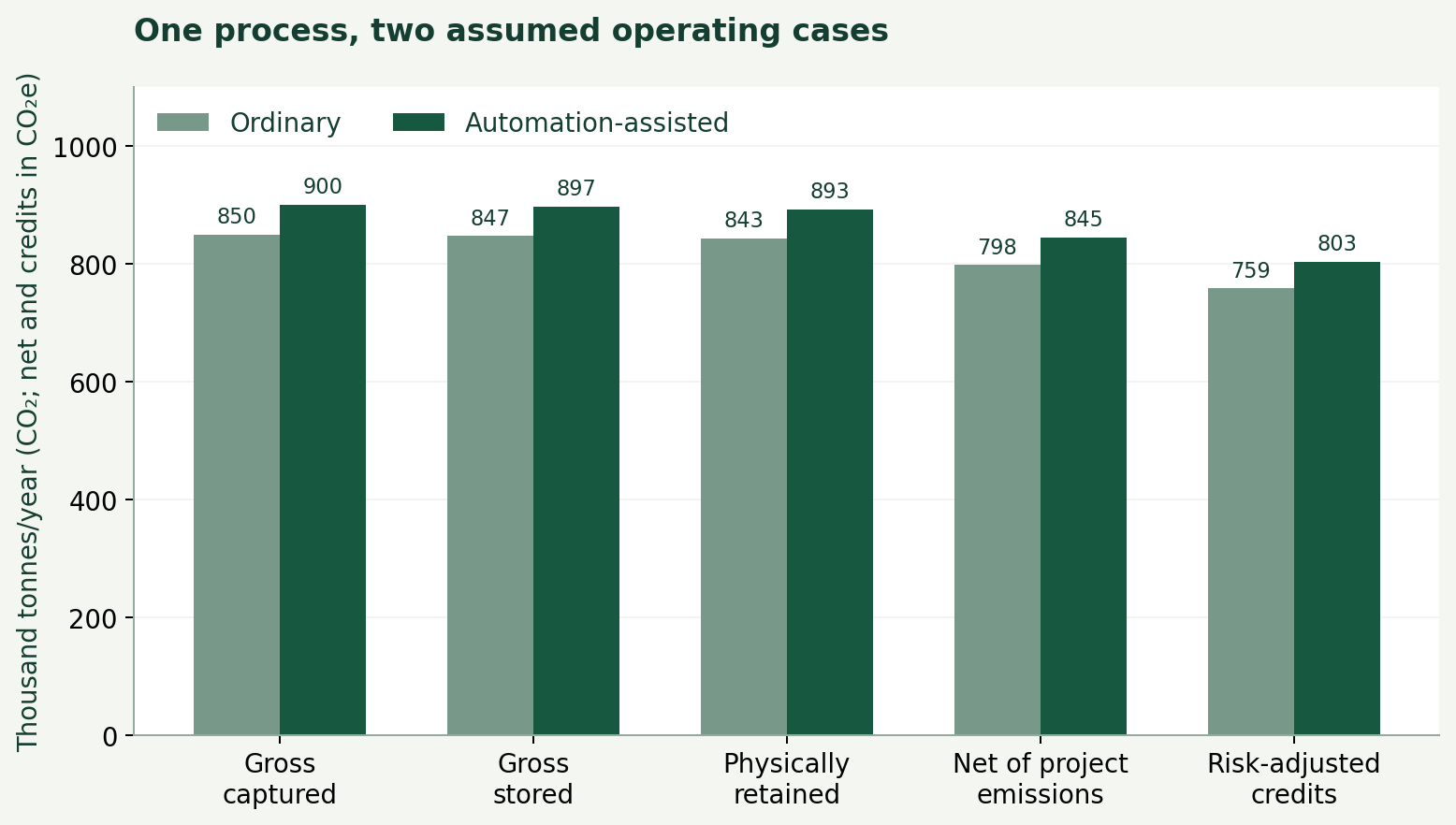
WHAT IT SHOWS
Ordinary and automation-assisted cases share all per-tonne physical assumptions. The assumed availability improvement raises gross capture from 850,000 to 900,000 tonnes/year. Losses, project emissions and credit buffers remain explicit.
READ WITH CAUTION
Inspect the source table The difference is conditional on assumed uptime and task productivity. It is not measured automation performance. CO₂e accounting is not a species- and time-resolved climate prediction.
The tightest constraint sets the output.
AETHER model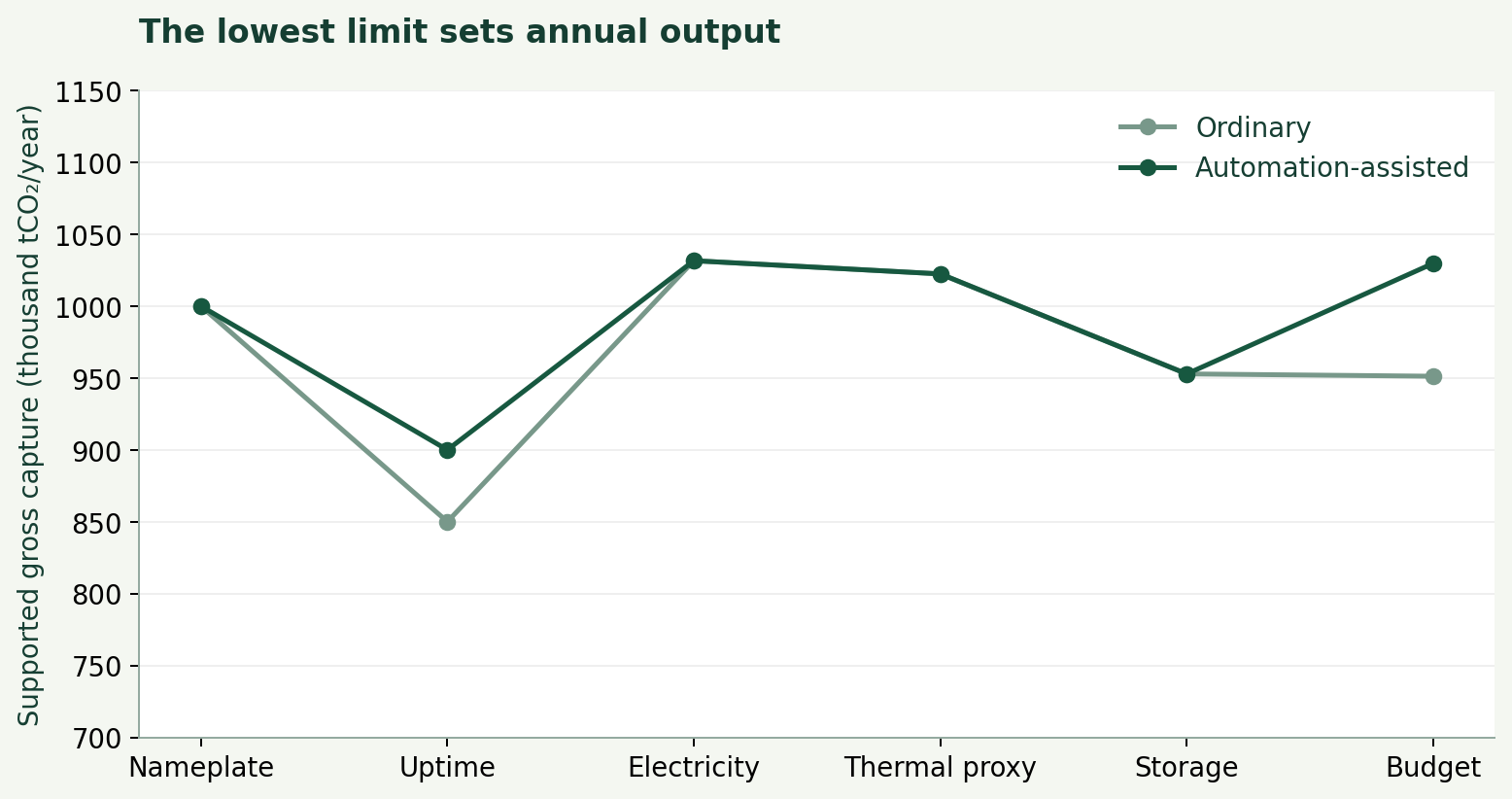
WHAT IT SHOWS
The model takes the minimum of nameplate, availability, electricity, thermal-energy allowance, injection and budget. Halving electricity, the thermal allowance or storage removes the output advantage of the automation case.
READ WITH CAUTION
Inspect the source table This is an annual resource envelope, not hourly dispatch, a permitted site or a construction design. The graph's vertical axis starts at 700,000 tonnes/year to make differences readable.
Two services need two identified funding sources.
AETHER model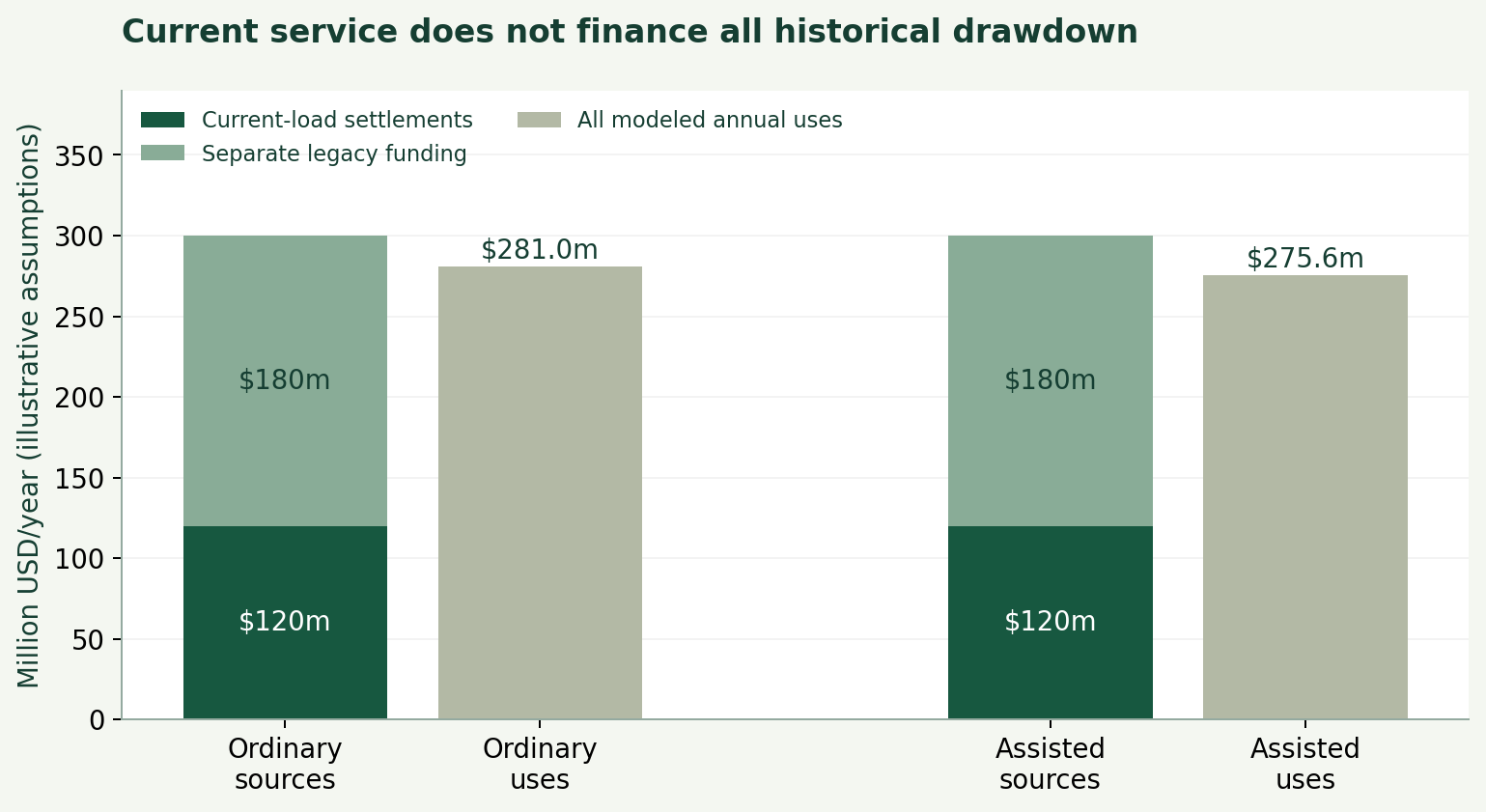
WHAT IT SHOWS
An illustrative current-load settlement funds part of the annual service. Separate legacy funding covers the wider drawdown program. Capital charges, labor, automation, energy, storage and reserves are counted once.
READ WITH CAUTION
Inspect the source table These are explicit funding and price assumptions, not available revenue, a recommended tariff, an investment return or a cost forecast. A positive annual balance does not establish full long-term solvency.
03 / WHAT IS NOT ESTABLISHED
Confidence should follow evidence.
Absolute climate projections
The replacement baseline failed a zero-future-emissions diagnostic. Absolute concentration, temperature and arrival-date claims are quarantined. Historical carbon reservoirs and consistent emissions inputs must be resolved first.
The old Monte Carlo headline
Sampling hand-set ranges measures those assumptions, not the likelihood of AETHER succeeding. The public headline no longer uses a pass percentage. Correlated cases also change marginal assumptions.
The global model suite
Power, robotics, storage and cost screens do not yet share a complete regional, chronological resource contract. Favorable standalone outputs cannot be added into a validated deployment path.
Real operating conditions
Hourly power and heat, field automation data, basin-specific storage, independent verification, full lifecycle impacts and long-term funding remain open research tasks.
CONTRIBUTE
A better parameter can change the conclusion.
Reproduce the regional case, challenge its assumptions, or bring evidence for one missing constraint. The most useful contribution has a source, a unit, an uncertainty range and a clear account of what it changes.
Review and contribution guide